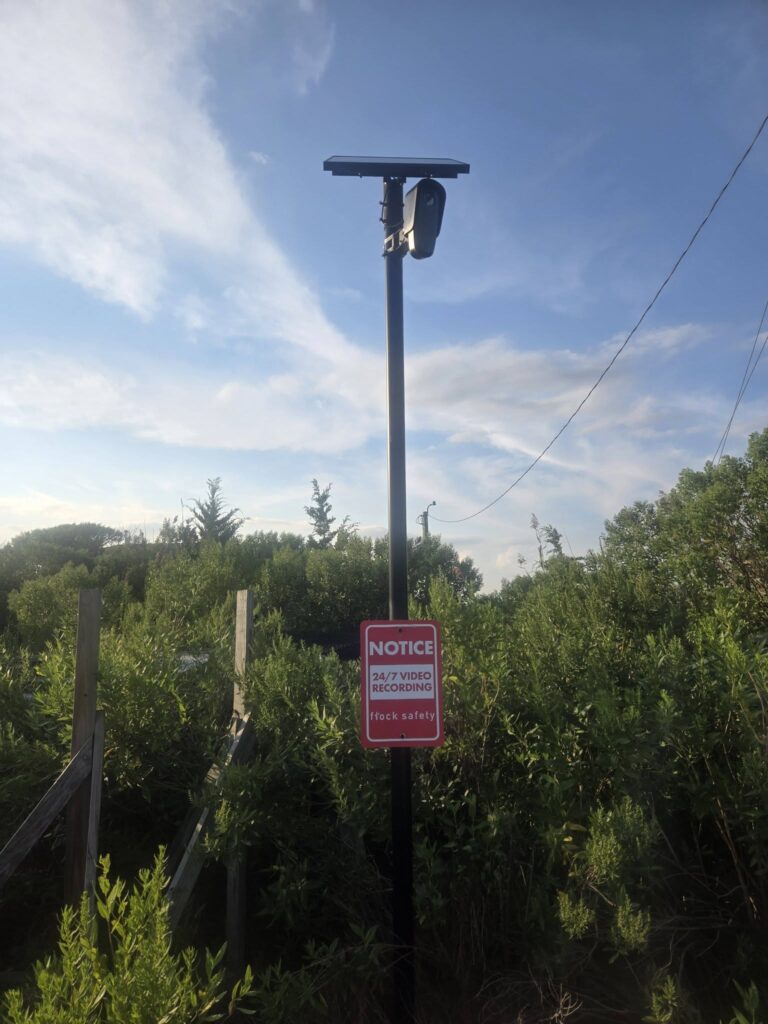
I live at Money Island, NJ, a one-road town with six residents and a commercial port that supports about a dozen marine and fishing businesses. One dead-end road runs for miles to our waterfront community and stops at the water in front of my home and business. A second road crosses to the other properties. That is the whole town.
This week a photo of my home with the Flock safety camera on it went around social media, and the response was harsh. I understand it. Here is how that camera got there.
Our isolation, combined with the amount of valuable equipment here, made us a target. Crime spiked during the COVID shutdown. I lost much of my business equipment. Windows were shattered. Gates and locks were busted. Metal was ripped out and stolen from under my home. I was never able to afford to replace it, so some of the buildings, the rental boat business, and the fishing business never reopened. One night I walked into a break-in at a neighbor’s home without realizing what was happening, and I was physically attacked. My neighbor urged me to get a gun. For personal reasons, I did not. Better security was the alternative, and it was necessary for our survival here.
We were not new to it. We installed videotape security in the 1990s, as many businesses did. Tape gave way to other storage, and we put up the generic signs announcing that the community was monitored. Whenever there was a disturbance, the state police or a neighbor would ask me for a copy of the recording. It was a burden. I never developed much skill with the equipment, and the recordings were often poor anyway. I used to joke that the system had a knack for malfunctioning right before anything important happened. I suspect some officers and neighbors did not believe me when I said I could not produce what they asked for.
When remote monitoring arrived, I encouraged what I called community-based security. Neighbors could tune in from their own homes and watch activity at the scattered marina properties. The point was to take the pressure off me as the sole gatekeeper of the island’s security. People would text me when they saw something unusual. It worked better than anything I could do alone.
Technology kept moving. At some point it became clear that the single most useful piece of information after a crime is a license plate, and my cameras were not good at capturing them. We asked around. Flock had the best plate cameras, so one went up on my building. I contributed money toward the cost. It worked well for years. Several crimes were solved with information it provided. Local government and police praised it. I mentioned it at a township committee meeting and everyone seemed pleased. I posted about it regularly, boasting that a rural town of six people had the best security monitoring anywhere around. I believed that the more people who knew about the camera, the safer we would be.
Then the ground shifted. Over the past few years Flock has drawn serious criticism over how plate data is shared and used, and public feeling has turned hard against government surveillance in general. News reports indicated that data from remote cameras like ours was available to law enforcement nationwide. Our understanding of the power of AI grew. There are credible reports of abuse of the data. A large portion of the community is strongly opposed to Flock. Some politicians are discussing banning them outright. That is a different thing from what I thought I was installing, at a time when public trust in law enforcement is low.
I should be clear about one thing, because the story does not make sense without it. I never signed a contract with Flock. Someone else’s name is on that agreement. I have spent forty years not discussing other people’s private business in public and I am not going to start now. What I can say is that the camera is on my property. Whatever that contract says, the equipment sits there because I allowed it and initially supported.
In defense of Flock: I can look back now and say that the post-covid restoration of Money Island would not have begun so soon without the safety and security that Flock extended. The police could not help us. The government did not help with the cost of recovery from the covid era crime wave. Flock was (and maybe still is) the only system that can provide simultaneous real private and police protection including license plate identification to a vulnerable site like ours.
I already stopped contributing to the cost of the Flock system more than a year ago and installed a better and more private camera system of my own. A few months ago I emailed Flock and told them the camera should come down. I gave them a reason that was easier than the real one: planned redevelopment of the site, which is still years away. They responded by citing a contract. I did not take the time to investigate further.
I should have given them the actual reason, and I should have followed through. I will do that now. I will find out what the contract actually says, and I will decide based on that and give an answer to the community within the next week.
I sat down to write this after noticing that the fear I felt years ago – the fear that made me install a state-of-the-art security system in the first place – has come back. This time the fear is coming from the hostile reaction of the community to the security system itself.